
BLOOMINGTON, Ind. — Evolutionary experts at Indiana University have identified a biological adaptation in Generation Z that allows for the rapid processing of extremely high levels of caffeine, researchers said Monday.
Dr. Katilynn Miller, chief of human processes at Indiana University, described the development as a second, smaller heart-like organ located near the left lung. Miller said the organ allows those born between 1997 and 2012 to process up to 1,000 milligrams of caffeine without experiencing organ failure, heart attacks, or “manual blinking.”
“This is possibly the biggest evolutionary development we have seen in over 10,000 years,” Miller said. “It is a potent example of Darwinism.”
The discovery has also generated excitement among energy drink companies. Emmitt Randall, CEO of Volted Beverages, said the new organ could dramatically increase caffeine consumption nationwide.
“Here at Volted, we are very excited about this development,” Randall said. “With this new organ, we are likely to see a rise in sales as the amount of possible caffeine consumption increases.”
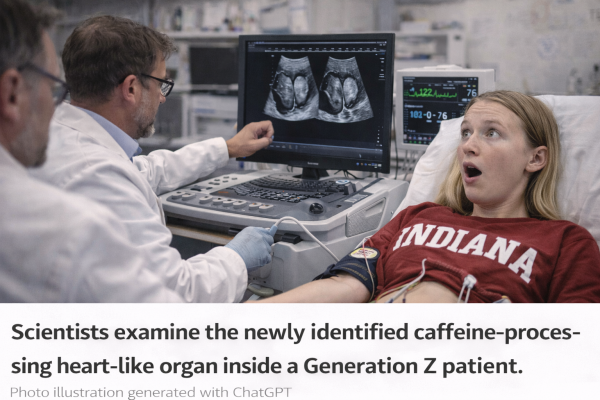
At Madison Consolidated High School, the physiological shift is already having an impact in the classroom.
“The new opportunities are limitless,” junior Cole Goodknight said after reportedly consuming two Red Bulls and three Alani Nu energy drinks in a single morning. “I honestly could go for another one.”
While some students, such as sophomore Rachel Johnson, praised the organ for making 3 a.m. study sessions possible, others pointed to troubling side effects. Freshman Madiline Henderson reported that her classmate, Lizzy Brown, has been awake for a week and has begun “vibrating at hyperspeeds.”
The phenomenon has raised a variety of reactions from MCHS faculty.
“I am just happy to see kids awake during class,” math teacher Mr. Richards said. “The downside is that a humming noise is coming from the back corner of my second period.”
Richards added that the sound is slightly concerning and that he is not entirely sure what to do about it.
P.E. teacher Mr. Blake said the adaptation has made traditional gym metrics nearly useless.
“The kids are unable to keep a steady pace during warmups,” Blake said. “They either sprint across the gym at full speed or vibrate in place like a phone on silent.”
Scientists at Indiana University say they will continue studying this nearly electric version of the human heart in hopes of better understanding how it works and how it may continue to evolve.
Until then, students at MCHS will continue pushing the limits of caffeine consumption, proving that this discovery may be only the beginning of a very energetic future.